The 5 Whys Explained: A Guide to Better Incident Investigation
If you find yourself lost trying to solve a problem —whether it’s a technical issue, a process failure, or a safety incident—a great place to start would be asking yourself “Why?”. The answer may not be immediately clear, but asking the question of why? repeatedly can help to begin peeling back the layers of a problem, revealing the true root cause/s. This method of consistently asking why in response to an incident is known as the 5 Whys Methodology
In this blog, we’ll explore how the 5 Whys method works, why it’s effective, and how it can be applied to a variety of scenarios—from day-to-day operational challenges to complex safety incidents.
Brief History
Before we dive deeper, how did this method come about? The 5 Whys technique was developed by Sakichi Toyoda, founder of Toyota Industries, in the 1930s. At first, it wasn’t developed for root cause analysis as we know it today. Instead, it was used to explore why new product features or manufacturing techniques were necessary. From then until today, the 5 Whys technique has been widely used across many industries.
What is 5 Whys Method
So, what exactly is the 5 Whys Method and why is it popular? Its appeal lies in its simplicity — when we encounter a problem, it helps us get to the immediate, underlying, and root causes quickly. And it’s just as straightforward as it sounds: you ask “Why” 5 times (or fewer) until you reach the root cause of the problem.
What sets this technique apart is that it goes beyond quick fixes or band-aid solutions. By continuously digging deeper, it helps us uncover the underlying issue that, if left unaddressed, could lead to recurring problems. And one of the best parts of this technique? No special tools nor software are needed, just a critical mindset and logical thinking.
How it works
1. Identify the problem clearly. Make sure the problem is brief but specific. A vague problem statement will lead to vague answers, so it’s important to define it in a way that captures the issue precisely.
2. Ask the first why to identify the immediate cause. This may seem straightforward but requires careful thought. The answer to this “Why” should be based on actual accounts, not assumptions or guesses. This avoids hypothetical solutions and keeps the inquiry grounded. Keep in mind that there could be more than one answer to a “Why”, which could lead to a multiple-strand inquiry.
3. Continue asking “why” four more times (or fewer), until you reach the root cause. After identifying the underlying cause, ask “Why?” again. Repeat the process until you get to the root cause that fully explains the problem.
4. Address the root cause. The 5 Whys method isn’t just to uncover the root cause, but to develop countermeasures that address them and prevent the issue from happening again. Root causes are always organizational or people issues – NOT technical issues.
5 Whys in Action
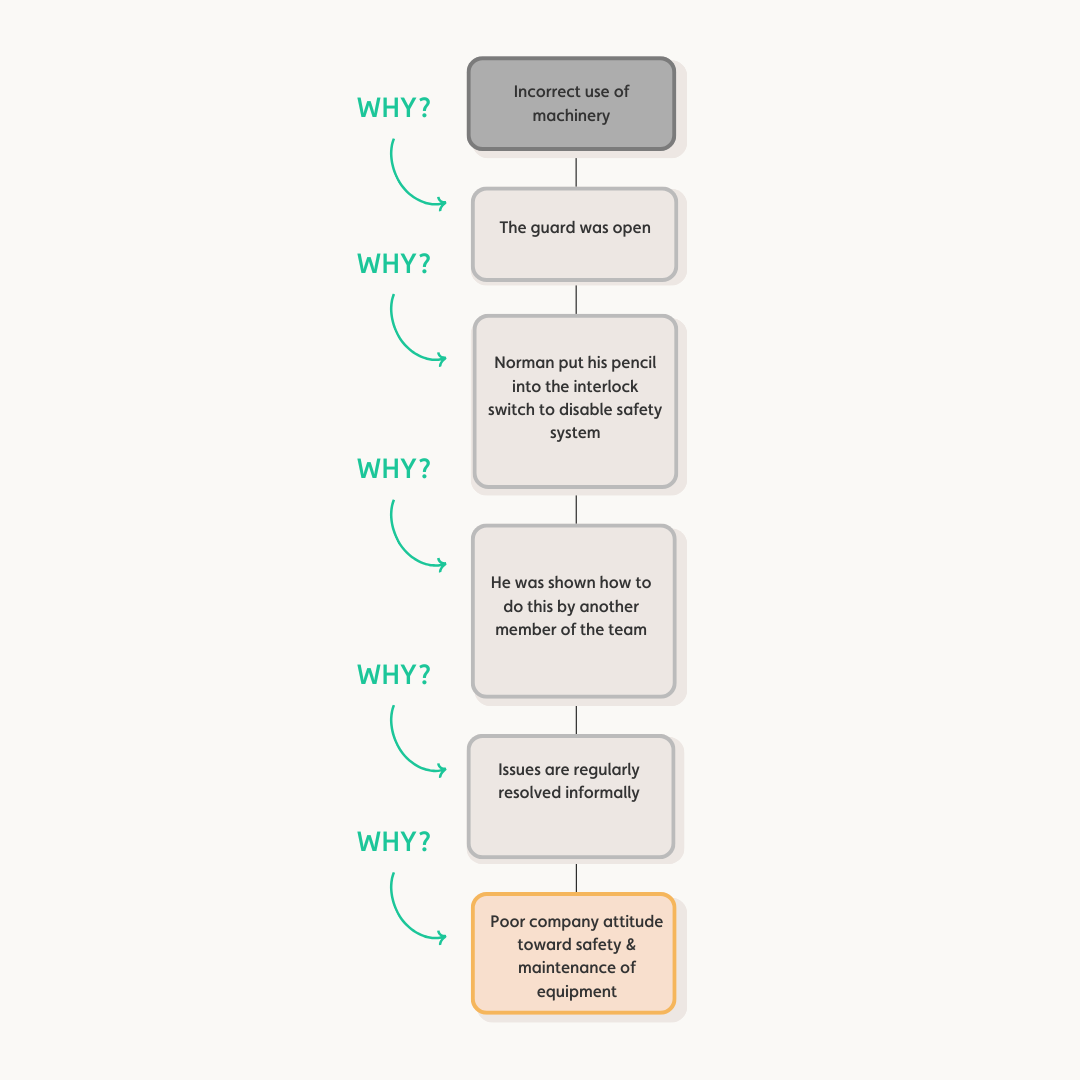
To see the 5 Whys method in action, we will be using our favorite Edge Gluer Case Study.
In this example, we will identify the problem statement and ask “Why?” repeatedly until we reach the root cause.
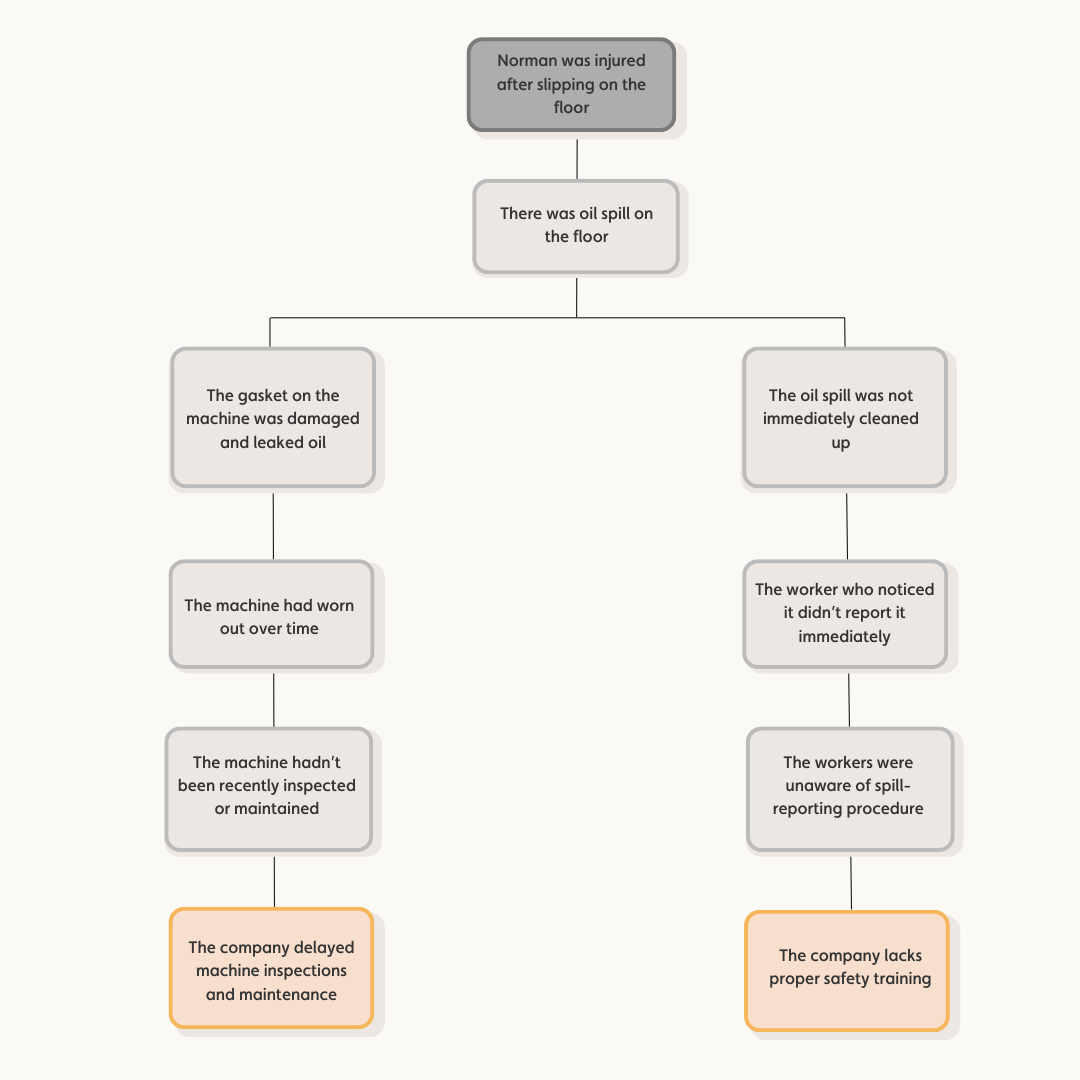
Here is another example of a 5 Whys analysis that has multiple strands, as seen in Figure 2. In this case, two immediate causes stemmed from the first one, which is “There was oil spill on the floor”. After several more “whys”, we discover that the injury resulted from two distinct root causes: equipment failure due to inadequate maintenance and lack of safety training. Both root causes should be addressed to prevent future accidents.
Tips for an Effective 5 Whys
1. Involve the right team. Gathering people who understand various aspects of the issue can give insights into different areas.
2. Know when to stop. A common mistake is stopping after just one or two “whys”, thinking the root cause has been found. This can lead to addressing a symptom instead of the real issue. This is a matter of judgement. Avoid stopping too early — continue asking “Why” until you’re confident the root cause has been uncovered.
3. The “5” in 5 Whys is just a guideline. Since the process is flexible, you may uncover the root cause at the third or fourth “Why”.
4. Move on quickly to the next question. Focusing too long on the first “why” can result in tunnel vision, limiting your understanding of the broader of picture. Keep the process moving to get a well-rounded view of the problem.
5. Document every step of the analysis. Whether you’re using sticky notes or PowerPoint, it’s important to have proper documentation of the process. This ensures transparency and consistency. Tools like Incident Insight make it easy to track the 5 Whys method in real time. With the ability to upload supporting documents such as photos or witness statements, and a clear timeline of events, it ensures that every detail is captured.
Conclusion
The 5 Whys is a powerful tool in every problem-solver’s toolkit, helping organisations quickly uncover the root cause of issues and implement long term solutions. Whether the problem is big or small, the next time something goes wrong, try using the 5 Whys method to get to the bottom of it.
Curious how your team can apply this technique? Book a demo here.